Monday, 1 December 2014

Ten Weirdest Things in Space

The more we look among the star and galaxies, the weird things seem to get. Even space itself is puzzling, for example. Recent studies suggest that the fabric of the universe stretches more than 150 billion light years across--in spite of the fact that the cosmos is 13.7 billion years old. From super-fast starts to the nature of matter, here we cover other starnge and mysterious elements of the universe.

1. Hypervelocity Stars 
If you've ever gazed at the night sky, you've probably wished upon a shooting star (which are really meteors).
But shooting stars do exist, and they're as rare as one in 100 million. In 2005, astronomers discovered the first "hypervelocity" star careening out of a galaxy at nearly 530 miles per second (10 times faster than ordinary star movement). We have ideas about what flings these rare stars into deep space, but aren't certain; anything from off-kilter supernova explosions to supermassive black holes might be responsible.

2. Black Holes
Speaking of black holes, what could be stranger?
Beyond a black hole's gravitational border -- or event horizon -- neither matter nor light can escape. Astrophysicists think dying stars about three to 20 times the mass of the sun can form these strange objects. At the center of galaxies, black holes about 10,000 to 18 billion times heavier than the sun are thought to exist, enlarged by gobbling up gas, dust, stars and small black holes. What about mid-sized types? Perhaps surprisingly, evidence is both scarce and questionable for their existence.

3. Magnetars
The sun spins about once every 25 days, gradually deforming its magnetic field. Well, imagine a heavier than the sun collapsing into a wad of matter just a dozen miles in diameter.dying star Like a spinning ballerina pulling his or her arms inward, this change in size spins the neutron star -- and its magnetic field -- out of control. Calculations show these objects possess temporary magnetic fields about one million billion times stronger than the Earth's. That's powerful enough to destroy your credit card from hundreds of thousands of miles away, and deform atoms into ultra-thin cylinders.
4. Neutrinos
Pull out a dime from your pocket and hold it up for a second... guess what? About 150 billion tiny, nearly massless particles called neutrinos just passed through it as though it didn't even exist. Scientists have found that they originate in stars (living or exploding), nuclear material and from the Big Bang. The elementary particles come in three "flavors" and, stranger still, seem to disappear on a whim. Because neutrinos occasionally do interact with "normal" matter such as water and mineral oil, scientists hope they can use them as a revolutionary telescope to see beyond parts of the universe obscured by dust and gas.

5. Dark Matter
If you put all of the energy and matter of the cosmos into a pie and divvy it up, the result is shocking. All of the galaxies, stars, planets, comets, asteroids, dust, gas and particles account for just 4 percent of the known universe. Most of what we call "matter" -- about 23 percent of the universe -- is invisible to human eyes and instruments.
For now, Scientists can see dark matter's gravitational tug on stars and galaxies, but are searching feverishly for ways to detect it first-hand. They think particles similar to neutrinos yet far more massive could be the mysterious, unseen stuff.

6. Dark Energy
What really has everyone on the planet confused -- including scientists -- is dark energy. To continue with the pie analogy, dark energy is a Garfield-sized portion at 73 percent of the known universe. It seems to pervade all of space and push galaxies farther and farther away from one another at increasingly faster speeds. Some cosmologists think this expansion will leave the Milky Way galaxy as an "island universe" in a few trillion years with no other galaxies visible.
Others think the rate of expansion will become so great that it will result in a "Big Rip." In this scenario, the force of dark energy overcomes gravity to disassemble stars and planets, the forces keeping particles sticking together, the molecules in those particles, and eventually the atoms and subatomic particles. Thankfully, humankind probably won't be around to witness to cataclysm.

7. Planets
It might sound strange because we live on one, but planets are some of the more mysterious members of the universe. So far, no theory can fully explain how disks of gas and dust around stars form planets -- particularly rocky ones. Not making matters easier is the fact that most of a planet is concealed beneath its surface. Advanced gadgetry can offer clues of what lies beneath, but we have heavily explored only a few planets in the solar system.

8. Gravity
The force that helps stars ignite, planets stay together and objects orbit is one of the most pervasive yet weakest in the cosmos. Scientists have fine-tuned just about every equation and model to describe and predict gravity, yet its source within matter remains a complete and utter mystery.
Some think infinitesimal particles called gravitons exude the force in all matter, but whether or not they could ever be detected is questionable. Still, a massive hunt is on for major shake-ups in the universe called gravitational waves. If detected (perhaps from a merger of black holes), Albert Einstein's concept that the universe has a "fabric" of spacetime would be on solid ground.

9. Life
Matter and energy abound in the universe, but only in a few places is the roll of the cosmic dice perfect enough to result in life. The basic ingredients and conditions necessary for this strange phenomenon are better understood than ever before, thanks to abundant access to life here on Earth. But the exact recipe -- or recipes -- to go from the basic elements of carbon, hydrogen, nitrogen, oxygen, phosphorus and sulfur to an organism is a prevailing mystery. Scientists seek out new areas in the solar system where life could have thrived (or still may, such as below the surface of watery moons), in hopes of arriving at a compelling theory for life's origins.

10. The Universe
The source of energy, matter and the universe itself is the ultimate mystery of, well, the universe. Based on a widespread afterglow called the cosmic microwave background (and other evidence), scientists think that the cosmos formed from a "Big Bang" -- an incomprehensible expansion of energy from an ultra-hot, ultra-dense state. Describing time before the event, however, may be impossible.
Still, atom smasher searches for particles that formed shortly after the Big Bang could shed new light on the universe's mysterious existence -- and make it a bit less strange than it is today.

Source :- http://amazing-n-weirdworld.blogspot.in/2009/09/ten-amazing-things-about-space.html

Formation Of Earth - An Amazing History

The theory which explain the origin of earth and this Universe is called Big Bang Theory. According to this theory all matter in the Universe was, at one time, concentrated in a giant mass (a black hole?) that blew apart about 10 to 20 billion years ago (bya) and is still expanding.

Origin of Sun:
It is thought that our solar system had its origins when, about 5 bya, triggered by some unknown cause, a cloud of interstellar dust and gases collapsed and condensed. Some of the matter in the central mass contracted under its own gravity, condensed, and heated until forces were so strong that thermonuclear reactions began, and this was the origin of our star, the Sun.

Origin of Planets:
About 4.6 to 4.5 billion year ago, a disk-shaped cloud of subsidiary smaller lumps, pieces, dust, gases, etc. orbiting the sun subsequently coalesced and condensed to form theplanets, satellites, asteroids, comets, etc.

Formation Of Atmosphere:
 It is thought that Earth began as a cold world, and the very first atmosphere may have been hydrogen gas, but since that is so light weight and very chemically reactive, most of it would have floated off into space or reacted with other substances, thus would have been rapidly dissipated. Then some other volcanic activities and other chemical reaction took place.The inner four, solid planets have started out with similar atmospheres of H2O, CO2, CO, and N2. These chemicals made up the atmosphere of our planet for the first 1 billion years, and initially, provided similar atmospheres for the other three solid planets.However, the distance of each of these planets from the sun has influenced what subsequently took place there:
  • Mercury is too close to the sun and too hot. Any water that might have been there (and any other volatile chemicals) would, long ago, have evaporated into space.
  • Venus also is too close to the sun to have any surface water. 
  • Mars, on the other hand, is too far away from the sun, and so is too cold. Any water and carbon dioxide present on the planet are frozen solid in the “ice” cap. Also, the planet is too small to hold very much atmosphere, and there is not enough of a greenhouse effect to keep the planet warm. Thus, there is essentially no atmosphere left.
But these conditions happen to be just right here on planet Earth. We are just the right distance from the sun! On Earth, the heat and the size are such that the water is neither all frozen nor all vaporized. Because liquid water is present, this has enabled formation of the lakes and oceans needed for life to evolve.

Formation of Earth Surface:
Over the next 3.5 billion years, the amount of CO2 in our atmosphere was reduced as it became incorporated into rocks (limestone is CaCO3 and forms when H2O + CO2 --> H2CO3and H2CO3 + Ca++ --> CaCO3 + 2H+). The liquid oceans formed about 3.8 billion years ago, and life has been present for nearly as long. Evidence would indicate that on early Earth, there was much more volcanic activity, many more electrical storms, and more violent and destructive meteor impacts. Because of this impact heating (and Earth’s internal heat) the Earth subsequently melted, and heavier molten materials sank to the center, forming the core, while lighter ones floated to surface and formed the crust. Thus Earth now has several layers:
  • A central core composed of very dense metals such as iron and nickle
  • The mantle, which actually consists of several layers of varying composition, and is a molten, medium density, viscous liquid
  • The crust floats on the outside. Because the minerals in the crust are cooler, they have formed strong, rocky layers collectively referred to as the lithosphere.
Origins of Life:
The atmosphere was made largely of water vapor (H2O), carbon dioxide (CO2), carbon monoxide (CO), nitrogen (N2), methane (CH4), and ammonia (NH3). As the surface of Earth cooled again, torrential rains of this mixture formed the first seas, the “primordial soup.”
1. First, organic monomers (simple sugars, amino acids, fatty acids, and nucleotides) would have to be synthesized abiotically from inorganic substances like methane, carbon dioxide, and ammonia. Around all 20 amino acids, and a number of sugars, lipids, and nucleotides have been obtained from these inorganic substances(H2O, H2, CH4 and NH3)

2. The second step would be the formation of organic polymers and genetic material from the existing monomers (polysaccharides from simple sugars, proteins from amino acids, and RNA from nucleotides), possibly using hot sand or finely divided clay as a catalyst.

3. Thirdly, it is thought that non-living aggregates of these polymers formed. These may have exhibited some properties characteristic of living organisms, but were NOT ALIVE, and did not have all the properties of living organisms. In a research laboratory, scientists have seen mixtures of proteins, lipids, and carbohydrates form globules. If the proteins involved happen to be enzymes, these globules can even carry on "metabolic" activity, although they have no means to replicate themselves. Several widely-accepted theories as to how this may have happened include the possibly involvement of damp, zinc-containing clay as a catalyst to help the nucleotides polymerize first into RNA, and later into DNA.
4. It is thought, then, that about 4.1 to 3.5 billion years ago, the first prokaryotes, like bacteria, came into existance. It is difficult to pinpoint a date for this because bacteria don't have skeletons to leave behind. The first “fossils” (remains of colonies/secretions) of prokaryotes seem to be this age. Once the first cells, the first living organisms, the first prokaryotes came into existance, then the Theory of Evolution takes over to provide an explanation for how (not why) these primitive cells diversified into the five kingdoms of life which we recognize today.
Initially, the energy needed for growth and development was supplied by glycolysis and fermentation. There was no free oxygen in the early atmosphere, and indeed, any organisms living back then would have probably been poisoned/killed by this highly-reactive chemical. Only later, as photosynthetic organisms released increasing amounts of this toxic waste into the atmosphere, did the process of cellular respiration evolve as a means of making use of this oxygen.

Source :- http://amazing-n-weirdworld.blogspot.in/2009/10/formation-of-earth-amazing-history.html

10 Amazing Species - About to Disappear!!

1.Slender Loris
The slender loris, Loris tardigradus is classified as Endangered (EN A2cd+4cd) on the IUCN Red List 2004. The grey slender loris, Loris lydekkerianus is classified as Near Threatened (NT) on the IUCN Red List 2004. Two subspecies of slender loris, Loris tardigradus exist. 

The most distinguishing characteristics of the slender lorises are their very long, slender arms and legs, which give these species their names. They usually have a grey or reddish coat, although this varies according to subspecies, and the fur is soft, thick and woolly. Slender lorises do not have tails and move on all fours climbing or walking along branches. They do not have truly opposable thumbs and are only able to grasp things like food or branches with the whole hand, though they do have an extremely powerful grip. The eyes are large and round and the prominent ears are thin, rounded and naked at the edges. There is much confusion over slender loris classification.
 2. Yangtze River Dolphin -Baiji
It is/was a freshwater dolphin found only in the Yangtze Riverin China. Nicknamed "Goddess of the Yangtze" in China, the dolphin was also called Chinese River DolphinYangtze River DolphinWhitefin Dolphin and Yangtze Dolphin
According to Chinese legend, this graceful freshwater dolphin is the reincarnation of a drowned princessThe 2007 IUCN Red List classifies the Baiji as extinct. The Baiji population declined drastically in recent decades as China industrialized and made heavy use of the river for fishing, transportation, and hydroelectricity. 
The baiji is a graceful freshwater dolphin, characterised by a very long, slightly upturned beak and low triangular dorsal fin. Like other river dolphins, it has little need for vision in the muddy waters it inhabits, and as a result has tiny, barely functional eyes. It is pale blue-grey in colour with a white underside. The female is generally larger than the male.

3. Attenborough's long-beaked echidna
Recently classified as three separate species, long-beaked echidnas belong to an ancient clade of egg-laying mammals that includes the platypus of Australia. They are easily distinguished from short-beaked echidnas by their long snouts, which account for two-thirds of the length of the head. Despite laws designed to protect these species, they are in decline in areas accessible to humans. Echidnas have lost much of their forest habitat to logging, mining and farming, and are regarded as highly prized game animals by local people. Size: Head and body length: 450-775 mm and Weight: 5-10 kg.
The most distinguishing feature of long-beaked echidnas is their long snouts, which curve downwards and account for two-thirds of the length of the head. They have no teeth; instead their tongues are covered in spikes (teeth-like projections), which are very effective in hooking prey and drawing it into the mouth. They have compact, muscular bodies, with strong limbs and claws for digging. Their back and sides are covered with spines, which vary in colour from white through to dark grey or black. The body is also covered in brownish-black hairs, which sometimes hide the spines. Males are larger than females and have spurs on the inside of the hind limbs, near the foot. 

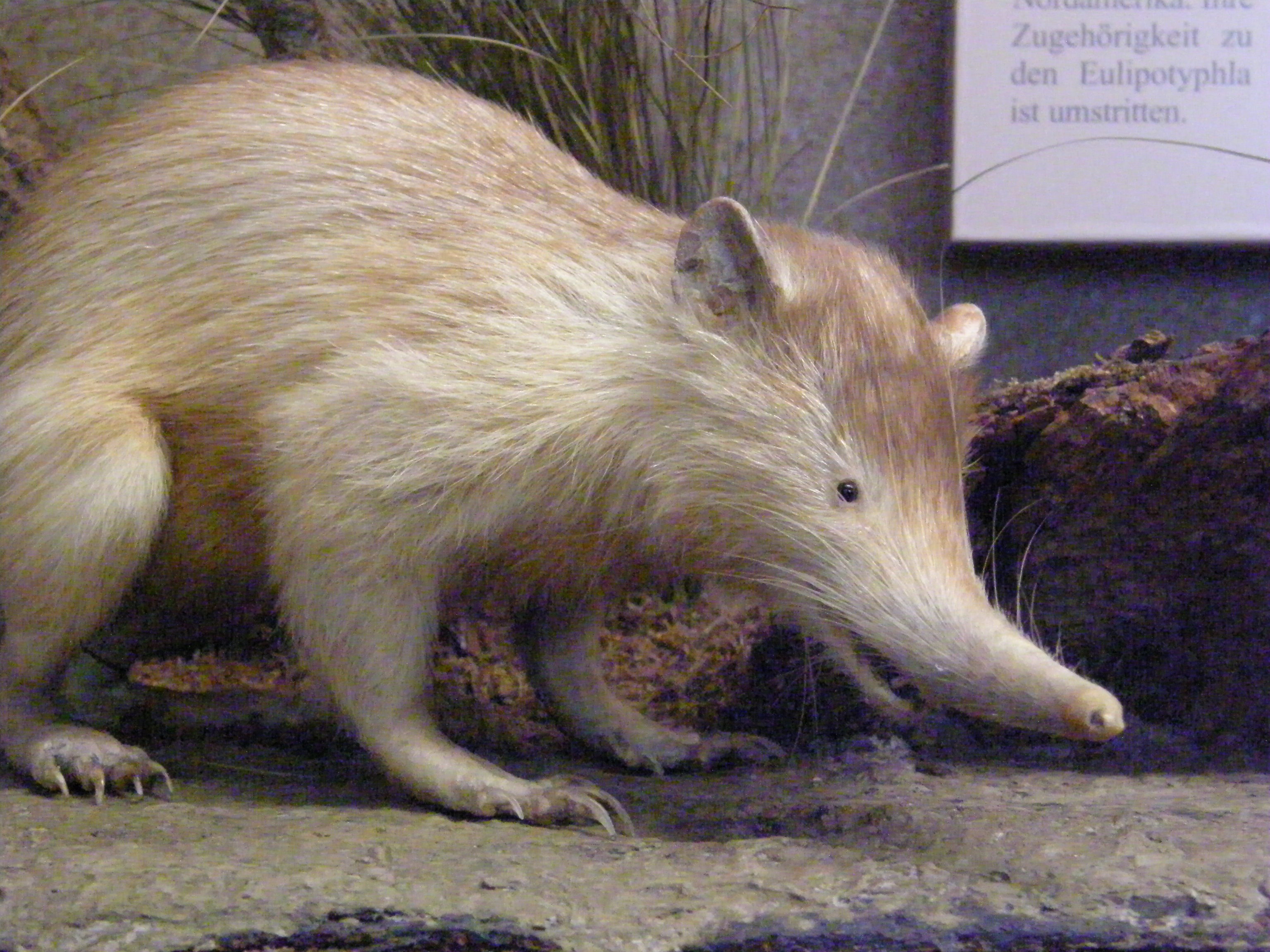
4. Hispaniolan solenodon
Also known as the Haitian Solenodon or Agouta, is a solenodon only found on the island of Hispaniola, shared by Haiti and the Dominican Republic, and was unknown to science until 1833, when it was first described by Brandt. 
It weighs between 0.6 and 1.0 kg, and is 28 to 33 cm long (the tail measures an extra 25 cm). It has brownish-red fur on most of its body, the underside being a lighter shade. The tail, legs, snout and eartips are hairless. The forelegs are noticeably more developed than the hind ones, but all have strong claws useful for digging. The head is very big in relation to its body, and it has a long rostrum with tiny eyes and ears, partially hidden by the body fur.
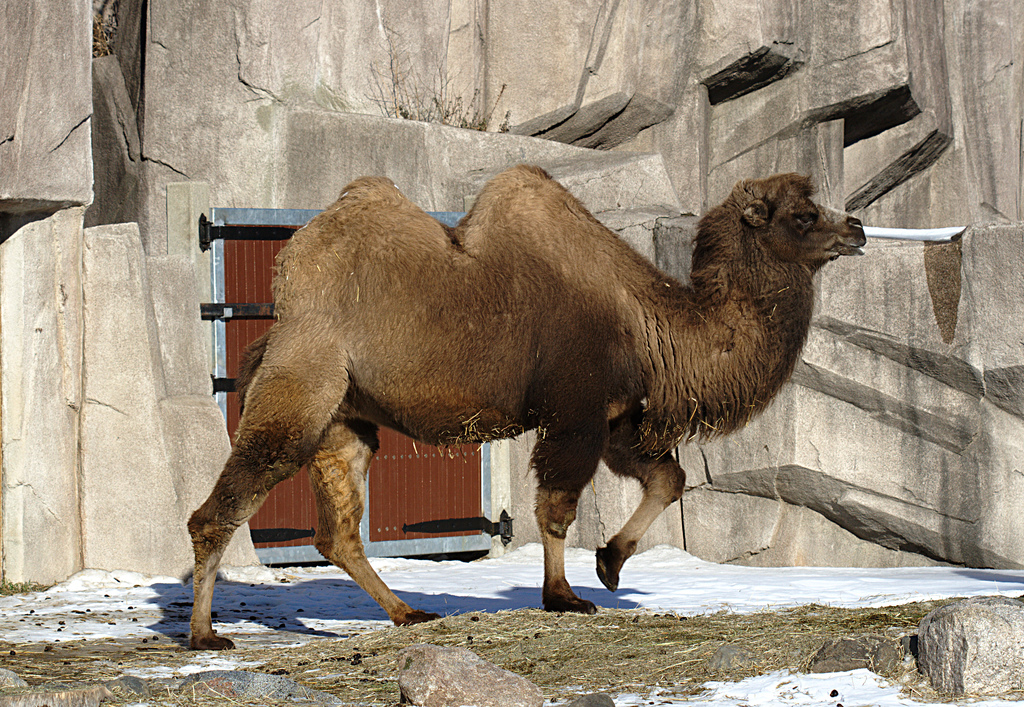
5. Bactrian Camel 
The Bacterian camel (Camelus bactrianus) is a large even-toed ungulate native to the steppesof north eastern Asia. It is one of the two surviving species of camel. The Bactrian Camel has two humps on its back, in contrast to the single-humped Dromedary Camel. Nearly all of the estimated 1.4 million Bactrian Camels alive today are domesticated, but in October 2002 the estimated 950 remaining in the wild in northwest China and Mongolia were placed on the critically endangered species list. 
6.Pygmy Hipopotamus


Thpygmy hippopotamus (Choeropsis liberiensis or Hexaprotodon liberiensis) is a large mammal native to the forests and swamps of western Africa (the scientific species classification means "of Liberia", as this is where the vast majority live). The pygmy hippo is reclusive and nocturnal. It is one of only two extant species in the Hippopotamidae family, the other being its much larger cousin the common hippopotamus.
The pygmy hippopotamus displays many terrestrial adaptations, but like its larger cousin, it is semi-aquatic and relies on proximity to water to keep its skin moisturized and its body temperature cool. Behaviors such as mating and giving birth may occur in water or on land. The pygmy hippo is herbivorous, feeding on whatever ferns, broad-leaved plants, grasses and fruits it finds in the forests.


7. Long eared jerboa
The Long-eared Jerboa, Euchoreutes naso, is anocturnal mouse-like rodent with a long tail, long hind legs for jumping, and exceptionally large ears. It is distinct enough that authorities consider it to be the only member of both its genus, Euchoreutes, and subfamily, Euchoreutinae.
It has been reported in China and in ten localities in desert habitats of Trans Altai Govi Desert and the Gobi Desert in Mongolia. A large part of the species is believed to occur in Mongolia within protected areas. Very little is known about the species.

8. Bumblebee bat
Kitti's Hog-nosed Bat(Craseonycteris thonglongyai), also known as the bumblebee bat, is about 29–33 millimetres (1.14–1.30 in) in length and 2 grams (0.07 oz) in mass), hence the common name of "bumblebee bat". It is the smallest species of bat and may be the world's smallest mammal. It is a vulnerable species of bat and the only member of the family Craseonycteridae. It occurs in western Thailand and southeast Burma, where it occupies limestone caves along rivers.
Kitti's Hog-nosed Bat is the smallest species of bat and one of the world's smallest mammals. It has a reddish-brown or grey coat, with a distinctive pig-like snout. Colonies range greatly in size, with an average of 100 individuals per cave. The bat feeds during short activity periods in the evening and dawn, foraging around nearby forest areas for insects. 


9.Golden Rumped Elephant shrew
The Golden-rumped Elephant Shrew (Rhynchocyon chrysopygus) is the largest of the African elephant shrew family. It is the size of a small rabbit, and is only found in the coastal Arabuko Sokoke National Park north of Mombassa in Kenya. 
The Golden-rumped Elephant Shrew lives on the forest floor of evergreen forests, rooting through the leaf litter for 80% of the waking day looking for grasshoppers, beetles, spiders and other small invertebrates.
It is very fast, capable of running at 25km/h. When it detects a predator within its 'flight distance' it will bound off. If, however, the predator is outside its flight distance the elephant shrew will advertise its presence by slapping the leaf litter. As a final precaution each shrew has several nests which it maintains, thus a predator finding a nest will not learn to associate them with potential food.

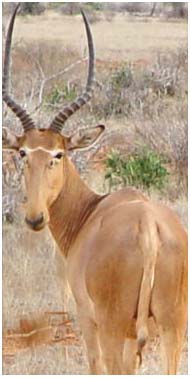
10. Hirola


The Hirola (Beatragus hunteri, sometimes Damaliscus hunteri also known as Hunter's Hartebeest) is an antelope species found in arid grassy plains in a pocket on the border between Kenya and Somalia. It's the only member of the genus Beatragus.
Hirola are known as the "four-eyed antelope," due to their large preorbital glands. Hirola stand 100 to 125 centmetres at the shoulder and weigh 80 to 118 kilograms. Their coat is a sandy brown colour, greyer in males than females, with a lighter underbelly and a small white strip over the bridge of the nose. The nape of the neck has very thick skin which forms ridges when the ears are pricked up. The horns are lyre shaped and very conspicuously ringed.

Source :- 
http://amazing-n-weirdworld.blogspot.in/2009/11/10-amazing-species-about-to-disappear_03.html

Weired Things About Animals

There are presently over a million animal species upon planet earth. The reptiles have 6,000 species crawling in their habitats; and more are discovered each year. There are over 70,000 types of spiders spinning their webs in the world. Well, there are 3,000 kinds of lice. Yes, it is the lice we are prone to get due to lack of hair hygiene. This is a mind-boggling fact – for each of the 600 million people there is about 200 million insects crawling, flying.... Mammals are the only creatures that have flaps around their ears. The world has approximately one billion cattle, of which about 200 million belong to India.

Now some weird things about all these species:

  • The life of a housefly is only 14 days.
  • A dog was the first animal to up in space.
  • A sheep, a duck and a rooster were the first animals to fly in a hot air balloon. The oldest breed of a dog known to mankind is the ‘Saluki’.
  • An ostrich is the fastest bird and can run up to 70 km/h.
  • Never get a camel angry, for he or she will spit at you.
    • There are crabs that are the size of a pea. There are known as ‘Pea Crabs’.
    • The lifespan of 75 percent of wild birds is 6 months.
    • Denmark has twice as many pigs as there are people.
    • You do not need cotton buds to clean a giraffe ears. It can do so with its own 50cm-tongue.
    • Want to known the appetite of a South American Giant Anteater? Well it eats over 30,000 ants, per day.
    • The sailfish can swim at the speed of 109 km/h, making it the fastest swimmer.
    • The Sea Horse is the slowest fish, drifting at approximately 0.016 km/h.
    •  Elephants are the only animal that can't jump.
    • The small car on the road is probably the size of the heart of a blue whale.
    • The length of an elephant is the same as the tongue of a blue whale.
    • The crocodile's tongue is unmovable, as it is attached to the roof of its mouth.   
    • Emus and kangaroos cannot walk backwards.
    •  The smallest bird in the world is the Humming Bird. 
    • The praying mantis is the only insect that can turn its head 360 degrees.
    •  Armadillos, opossums and sloths spend up to 80 percent of their lives sleeping.
    • The Basenji is the only dog which does not bark.
    • The strongest animal in the world is the rhinoceros beetle. It can lift 850 times its own weight. 
    Source :- http://amazing-n-weirdworld.blogspot.in/2009/09/weired-things-about-animals.html

    Great Wall of China - World's Longest Wall

    The Great Wall of China was built over 2,000 years ago, by Qin Shi Huangdi, the first emperor of China during the Qin (Ch'in) Dynasty (221 B.C - 206 B.C.). In Chinese the wall is called "Wan-Li Qang-Qeng" which means 10,000-Li Long Wall (10,000 Li = about 5,000 km). The Great Wall of China is a series of stone and earthen fortifications in northern China, built, rebuilt, and maintained between the 5th century BC and the 16th century to protect the northern borders of the Chinese Empire from Xiongnu attacks during various successive dynasties. Since the 5th century BC, several walls have been built that were referred to as the Great Wall.

    The Great Wall stretches from Shanhaiguan in the east to Lop Nur in the west, along an arc that roughly delineates the southern edge of Inner Mongolia.  The most comprehensive archaeological survey, using advanced technologies, has recently concluded that the entire Great Wall, with all of its branches, stretches for 8,851.8 km (5,500.3 mi). This is made up of 6,259.6 km (3,889.5 mi) of sections of actual wall, 359.7 km (223.5 mi) of trenches and 2,232.5 km (1,387.2 mi) of natural defensive barriers such as hills and rivers.
      
    The majestic Great Wall was built with wisdom, dedication, blood, sweat and tears. It has been estimated that somewhere in the range of two to three million Chinese died as part of the centuries-long project of building the wall.

    Characteristics
    Before the use of bricks, the Great Wall was mainly built from Earth or Taipa, stones, and wood. During the Ming Dynasty, however, bricks were heavily used in many areas of the wall, as were materials such as tiles, lime, and stone. The size and weight of the bricks made them easier to work with than earth and stone, so construction quickened. Additionally, bricks could bear more weight and endure better than rammed earth. Stone can hold under its own weight better than brick, but is more difficult to use. Consequently, stones cut in rectangular shapes were used for the foundation, inner and outer brims, and gateways of the wall.

    Nearly everyone has heard of the Great Wall of China. As one of the UNESCO World Heritage Sites in China, The Great Wall is not just a wall, but a symbol of the bravery and wisdom of the Chinese people.

     He who has not climbed the Great Wall is not a true man.- Chairman Mao

    Source :- http://amazing-n-weirdworld.blogspot.in/2009/09/worlds-longest-wall-great-wall-of-china.html